The Way of the Bodhisattva by Shantideva
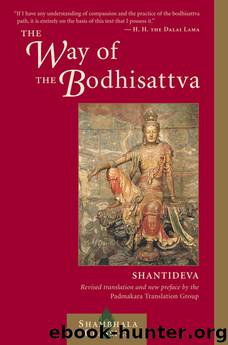
Author:Shantideva
Language: eng
Format: azw3, epub
ISBN: 9780834825659
Publisher: Shambhala
Published: 2007-11-06T05:00:00+00:00
9
Wisdom
1.
All these branches of the Doctrine
The Enlightened Sage expounded for the sake of wisdom.106
Therefore they must cultivate this wisdom
Who wish to have an end of suffering.
2.
Relative and ultimate,
These the two truths are declared to be.
The ultimate is not within the reach of intellect,
For intellect is said to be the relative.107
3.
In light of this, within the world, two kinds of people are observed:
Those with yogic insight and the common run of people.
In this regard, the views of ordinary folk
Are undermined by yogis who themselves are in the world108
4.
(Within whose ranks
The lower, in degrees of insight, are confuted by the higher)
By means of the examples that the yogis and the worldly both accept.
And for the sake of the result, analysis is left aside.
5.
When ordinary folk perceive phenomena,
They look on them as real, and not illusory.
This, then, is the subject of debate
Where ordinary and yogis differ.
6.
Forms and so forth, which we all perceive,
Exist by general acclaim but not by valid reasoning.
They’re false just like, for instance, unclean things
Regarded in the common view as pure.
7.
But that he might instruct the worldly,
Our Protector spoke of “things.”
But these in truth lack even momentariness.
Now if you say it’s wrong to claim the momentary as relative,
8.
There is no fault. For momentariness
Is relative for yogis, but for worldly beings, ultimate.
Were it otherwise, the common view
Could fault the yogic insight into corporal impurity.
9.
“Through a Buddha, who is but illusion, how does merit spring?”
As if the Buddha were existing truly.
“But,” you ask, “if beings are like illusions,
How, when dying, can they take rebirth?”
10.
As long as the conditions are assembled,
Illusions, likewise, will persist and manifest.
Why, through simply being more protracted,
Should sentient beings be regarded as more real?
11.
If one kills or harms the magical illusion of a man,
There is no mind in such a thing and therefore there’s no sin.
But beings do indeed have mirage-like minds;
Sin and merit will, in consequence, arise.
12.
There is no power in things like spells,
So mirage-like minds do not occur through them.
Illusions spring from various causes;
Thus illusions are of different kinds.
13.
A single cause for everything
There never was!
“If ultimately, beings are in nirvāṇa,” you will say,
“But relatively circle in saṃsāra,
14.
“Even Buddhahood reverts to the saṃsāric state.
So why,” you ask, “pursue the Bodhisattva path?”
As long as there’s no cutting of the causal stream,
There is no halting even of illusory displays.
15.
But when the causal stream is severed,
Even relative phenomena do not appear.
“If even that which is deceived does not exist,
What is it,” you will ask, “that sees illusion?”
16.
But if, for you, these same illusions have no being,
What, indeed, is there to be perceived?
“But objects have another mode of being,” you will say,
“That very mode is but the mind itself.”
17.
But if the mirage is the mind itself,
What is then perceived by what?
The Guardian of the World himself has said
That mind cannot be seen by mind.
18.
In just the same way, he has said,
The sword’s edge cannot cut the sword.
“But,” you say, “it’s like the flame
That perfectly illuminates itself.”
19.
The flame, in fact, can never light itself.
And why? Because the darkness never dims it!
“The blueness of a thing by nature blue,” you say,
“Depends, unlike a crystal, upon nothing else.
Download
This site does not store any files on its server. We only index and link to content provided by other sites. Please contact the content providers to delete copyright contents if any and email us, we'll remove relevant links or contents immediately.
The Way of Zen by Alan W. Watts(6574)
Ego Is the Enemy by Ryan Holiday(5389)
The Art of Happiness by The Dalai Lama(4114)
The Book of Joy by Dalai Lama(3958)
Why Buddhism is True by Robert Wright(3434)
Spark Joy by Marie Kondo(3284)
Shift into Freedom by Loch Kelly(3179)
Happiness by Matthieu Ricard(3030)
A Monk's Guide to a Clean House and Mind by Shoukei Matsumoto(2895)
The Lost Art of Good Conversation by Sakyong Mipham(2633)
The Meaning of the Library by unknow(2551)
The Unfettered Mind: Writings from a Zen Master to a Master Swordsman by Takuan Soho(2287)
The Third Eye by T. Lobsang Rampa(2247)
Anthology by T J(2194)
Red Shambhala by Andrei Znamenski(2175)
The Diamond Cutter by Geshe Michael Roach(2052)
Thoughts Without A Thinker: Psychotherapy from a Buddhist Perspective by Epstein Mark(2000)
Twilight of Idols and Anti-Christ by Friedrich Nietzsche(1882)
Advice Not Given by Mark Epstein(1869)
